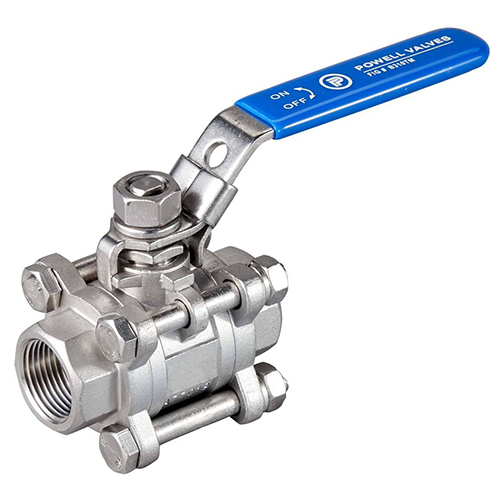
SS and FS Socketweld Ball Valve About
|
General
|
Product Name
Type
|
Socket Weld Ball Valve
SS , FS
|
|
Size Range
|
1/4" to 2" (15NB-50NB)
|
|
End Connection
|
Socket Weld (SW) & SCREWED
|
|
Port Type
|
Full Port / Reduced Port
|
|
Operation
|
Lever Operated / Gear Operated
|
|
Pressure Class
|
800#
|
|
Temperature Range
|
-20 deg C to 200 deg C (depends on seat material)
|
|
Standards
|
Design Standard
|
API 608 / BS 5351
|
|
Manufacturing Standard
|
ASME B16.34
|
|
Ball
|
SS 304 / SS 316
|
|
Stem
|
SS 304 / SS 316
|
|
Seat
|
PTFE
|
|
Gasket
|
PTFE
|
Rugged and Versatile ConstructionBuilt with stainless steel or forged steel, these ball valves ensure longevity and resistance to corrosion even in harsh environments. Options like SS304/SS316 body and ball components, glass-filled PTFE seats, and mirror-polished finishes deliver both robust performance and superior aesthetics-suited for heavy-duty cycles across industrial sectors.
Comprehensive Testing and Leak-Proof PerformanceEach valve undergoes rigorous testing in line with API 598 standards, guaranteeing Class VI bubble-tight shut-off. Detailed attention to quality assures users of reliable operation in critical applications where leakage is not an option, from chemical lines to oil & gas systems.
Flexible Application and Simple OperationWith a two-way channel and manual quarter-turn operation, these socket weld ball valves are adaptable to varied piping set-ups. Their insulated stainless steel lever and lockable handle provide safety and ease of use, while the optional ISO 5211 mounting pad supports automation if needed.
FAQ's of SS and FS Socketweld Ball Valve:
Q: How does a socketweld ball valve with quarter-turn operation function?
A: A socketweld ball valve with quarter-turn (90) operation uses a simple lever mechanism to rotate the ball inside the valve, swiftly opening or closing the flow path. This design ensures precise and rapid media control with minimal effort, making it suitable for operations requiring reliable shut-off or isolation.
Q: What are the corrosion protection features of these ball valves?
A: These valves are constructed from high-grade stainless steel (SS304/SS316) or forged steel (ASTM A105), and finished with corrosion-resistant, mirror or polished surfaces. This material and surface treatment combination provides excellent resistance to chemicals and harsh industrial environments.
Q: When should a fire-safe design and ISO 5211 mounting pad be selected?
A: A fire-safe design should be chosen when extra safety against leakage during high temperature incidents is required, such as in oil & gas or chemical plants. The ISO 5211 mounting pad option is beneficial when device automation is desired, enabling easy actuator installation without additional modifications.
Q: Where are these valves typically used?
A: These socketweld ball valves are widely used in industries such as petrochemical plants, water treatment facilities, chemical processing units, and oil & gas pipelines. Their robust construction and tight sealing make them an ideal choice for controlling various media in critical applications.
Q: What media can these ball valves handle?
A: They are suitable for handling water, oil, gas, air, steam, and a range of chemicals. Their PTFE or glass-filled PTFE seat material ensures compatibility with diverse fluids, while resisting degradation under high temperatures and pressure.
Q: How is leakage prevented during operation?
A: The valves are tested to API 598 standards and meet Class VI bubble tightness requirements, ensuring there is no leakage when the valve is closed. The use of high-quality PTFE seats further enhances sealing performance over long service cycles.
Q: What are the main benefits of installing these socketweld ball valves?
A: Primary benefits include high reliability, zero leakage, resistance to corrosion and high temperatures, ease of manual or automated operation, and adaptability to various pipe sizes (15mm to 100mm). Suitable locking arrangement and fire-safe options further enhance operator safety and system integrity.

 Send Inquiry


 Send Inquiry

 Send Inquiry